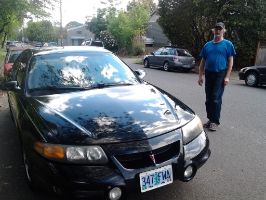
viper79 wrote:HOLD THE PHONE:
We may not have found the root, but are close to the source.
The ICM has been replaced 2 times in 18 months along with 9 total coils. I think "this hip bone is connected to the..." syndrome is happening again. However, we have found where the "gold" is coming from.
FP had 44 PSI at ignition. Rev is 56ish.
Cyl 1 wire had an erratic light show, but did not arc when water was sprayed on it. This is why I am thinking the ICM is bad. Yes, I'm a quick-study.
Mike, I'm ready to nail this bitch down and move on, bud.
ICMs repeatedly go bad when there is too much resistance in the circuit, such as a weak coil or a bad spark plug wire OR too much AC current in the circuit from a faulty alternator.
I'll quote myseklf here with the link
MKMike wrote:I came across an interesting article detailing the reasons for repeated ignition module failures.
You should find it quite helpful to your situation.
The article is on page 2 columns 2 and 3:
http://www.wellsve.com/sft503/counterp_v7_i2_20031.pdf
While the entire article was interesting, I would not have suspected that a failing alternator could wreak this particular havoc.
.
As pointed out in this article in Wells Counterpoint (they make aftermarket auto parts)
The "Fine Tuning" question in the January 2003
Counter Point concerned a 1992 Olds Delta 88
that has experienced multiple ignition module
failures. Along with the ignition modules, the
ignition coil, ignition wires, and spark plugs have
also been replaced. All system grounds have also
been checked for excessive voltage drops. What
could cause these ignition modules to fail?
There are three causes for repeat ignition control
module failures. The first and most common cause
is high resistance in the secondary ignition. On
this vehicle, this would include the ignition coil(s),
ignition wires, spark plugs and cylinder
compression. All of the ignition components
mentioned have either been recently replaced or
tested, so we should be able to rule them out.
There was no mention of a compression increase,
so for now I will assume all is well there.
The next most common cause for repeat module
failure would be a bad system ground. Voltage
drop tests have been performed on the system and
no problems were found, so I am also going to
assume everything is okay in this area
The last possible cause has to do with the charging
system. As the rotor in the alternator turns, it
generates an AC current in its windings. It is the
job of the rectifier bridge to convert this
AC voltage to DC voltage. If the rectifier
is beginning to fail, it will allow an
unhealthy amount of AC voltage to enter
the vehicle’s electrical system. Given
enough time, this AC voltage will cause an
ignition control module failure. It may also
damage other vehicle electronics.
To measure the amount of AC voltage that is
present in the electrical system, attach a digital
voltmeter to the battery and select the AC voltage
scale. While the engine is running you should not
see more than .5 AC volts on your meter.
Results: Tom checked and found .9 AC volts at the
battery. He replaced the alternator. The ignition
control module has been working fine ever since.
Although we did receive a large number of replies
to last issue’s "Fine Tuning" question, we did not
receive any correct answers. Most of the answers
we received pointed to an intermittent crank
sensor as the cause of the problem, which I find
interesting. Within the next few issues, we will
take a look at different crank sensor designs,
including how they function, what happens when
they become intermittent and how to test them.